Showing posts with label Status. Show all posts

Thursday, August 16, 2012

Return of the MERRA Blog

As many readers will understand, the demands on time can be many, and there is never enough time to do all that you want to do. Being spread thin for some time, the MERRA blog fell into neglect. However, with a lot of interesting things going on, from research with MERRA to formulating plans for subsequent reanalyses (and noticing in the last month a fair number of hits from around the world), I will be trying hard to find time to make regular posts.

The original purpose of the blog was to 1) follow the development of the MERRA system and eventually the production of data and then 2) follow the research that was being done with MERRA and other reanalyses. #2 never fully materialized, but there is a lot of work being published on reanalyses lately.  So, for the near future, summaries of published research or perhaps topical discussions involving several papers/reports will likely be the regular topic. However, new reanalysis development is on the horizon, as well.

Mostly, I figure that the hits on the MERRA blog are coming from internet searches for hard to find information, now that the MERRA overview paper is printed. This is an important issue, as users need to know if a reanalysis is applicable to a research topic, and its strengths and weaknesses. So, perhaps this can open the communication, just a little more.

Monday, August 1, 2011

Production Delay Resolved

TRMM TMI rainfall data updated to version seven, which included a format change (starting July 1). MERRA data production was put on hold while the data ingest of version 7 was updated. This was only a short delay. Current tests indicate no anomalous behavior in the time series that can be attributed to this change. June 2011 data should be online within a few days, and July production and distribution should be available by mid-August, back on schedule.

Friday, May 20, 2011

April 2011 Precipitation Extremes

During last April, record or near-record precipitation occurred across a large section of the United States (from the Midwest through the Ohio Valley). This rain, and likely snow melt from the Northern Great Plains, are contributing to the current prolonged and severe flooding along the Mississippi River and its delta. In addition, a prolonged drought of varying degrees persists across the Gulf Coast states.
MERRA precipitation (color shaded) with CPC gauge observations (black contour) time averaged for April 2011. (units: mm/day)

This week, MERRA data for April 2011 was released at the MDISC, roughly two weeks behind real time. Preliminary comparison with the CPC gauge data shows that MERRA precipitation is generally weaker than observed especially in southern Missouri, though the maximum in Pennsylvania is an overestimate. Because the reanalysis system is strongly constrained by observations, the weather systems that produce the rain, and hence the occurrence of rain events, are faithfully reproduced. The physical process of producing the precipitating water then leads to the error in the data product (assuming that the rain gauges capture the extent of the precipitating mass). It is worthwhile to note that MERRA does not assimilate precipitation observations over land, as in NARR.

Friday, October 29, 2010

Latest Data being reprocessed

Earlier this year, a compiler was upgraded on our supercomputing platform. This upgrade has apparently introduced a problem into the post processing program that compresses and prepares data files for transfer to the DISC where the data are publicly accessible. So that: all MERRA data after data date June 1, 2010 will be replaced and is currently no longer accessible at the DISC. This includes Monthly means from May 2010 on, but not the May 2010 data.

For those that may have downloaded data for the period June 1 - August 31, 2010, consider very carefully whether to continue using the data. So far, the only variables we have confirmed are corrupted are the roughness lengths for momentum and heat. We have no reason to think that other variables are not affected, hence the recall. The GMAO does not recommend the use of this data if you downloaded it before this recall.

The MERRA system and archive data are not affected by this issue. The system continues to run in near real time. Once the post processing code is fixed, the archive data will be reprocessed and posted to the DISC.

Late Oct 29 Update: The code has been fixed and tested. Corrected files are being reprocessed and sent to the DISC.

Tuesday, April 20, 2010

MERRA real time production schedule

Stream three has finished March 2010, signifying a transition to real time production schedule. Production will lag real time by approximately 3 weeks, allowing collection of all the observations used in the retrospective periods. We are planning one week to review and quality assure each new month's data files, before being sent to the GES DISC. So, Each new month of MERRA data will be available online roughly 1 month behind present time, and will be released in 1 month segments.

Jan-Mar 2010 are currently being reviewed and should be available on the DISC within the next couple of days.

Thursday, March 11, 2010

Update to Data Streams

We are updating MERRA data to permit longer spinup of streams 2 and 3. The announcement and how it affects data downloads follows. Data files formally available in the MERRA data streams are being renamed "SPINUP_*" and will also be available for download. Most research and applications for the data will only require use of the "Mainstream" MERRA data.

Updating of the MERRA data products site to contain only Mainstream data (http://disc.sci.gsfc.nasa.gov/mdisc/data-holdings/merra-mainstream-and-spinup-data) will begin Thursday, March 11, 2010. A two step procedure will be followed to achieve this. In step one, all current  products for the years 1989 through 1992 and 1998 through 2000 will be deleted. It is strongly advised that the MERRA data for the two aforementioned periods not be accessed until this data update is complete.  In step two,  
products will be used to repopulate these data years. We anticipate that it will take about two weeks to complete the data update. The remaining year
s of the data and all the MERRA data services will still be available during this time period. Once the update activities are completed, a new notification will be sent out and posted on the web. We thank you for your patience during this period. If you have any questions or concerns please send an email to the GES DISC User Services (help-disc@listserv.gsfc.nasa.gov).


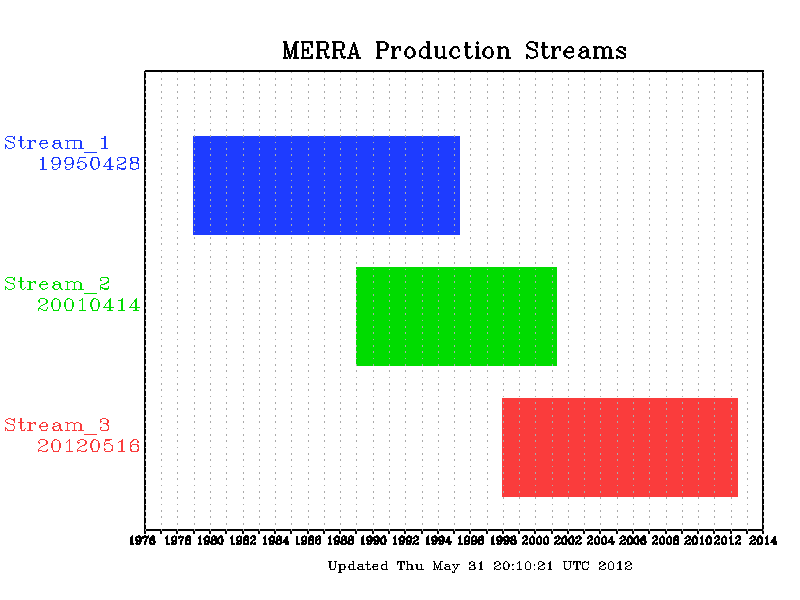
So when the update is complete, Stream 1 will contain 1979 through 1992, Stream 2 will have 5 years spinup (4 available for download) containing 1993 through 2000, and stream 3 will have 4 years spinup (3 available for download) containing 2001 through present.

2009 data should become available during the week of March 15.

Monday, February 1, 2010

MERRA Turns 30

Data availability at the DISC now extends for thirty years 1979 through 2008. This data is all online, and open to access. Production is presently in May 2009, and so should catch up to real time around the end of February. MERRA will continue into the future, as long as it is feasible to do so. At this point, we do not have a set production terminus.

Wednesday, January 13, 2010

MERRA Turns 30

31DEC2008 has just been produced by the reanalysis system. This extends the MERRA Mainstream to 30 Years. 2008 is still being checked for quality, but should be posted online at the MDISC within a week or so.

At approximately 1 year per six weeks, 2009 should be produced by the end of February. MERRA production will make a transition then, where we expect data to be released monthly. The production is delayed from real time to allow ingest of the most complete observations, but also to quality check the data files.

Thursday, December 24, 2009

Main stream and spinup data

The original plan for MERRA production was to run in three streams, optimizing the computers processes. The original three streams were 1) 1979-1988, 2) 1989-1997 and 3) 1998-present. These were initialized with 2 years of coarse resolution analysis, followed by 1 year at the native (1/2 degree) resolution. Recently, streams 1 and 2 caught up to the beginning of the respective subsequent streams, connecting the time series. Streams 1 and 2 were continued providing overlapping data with the beginning of the next streams, in order to test the variance of the system and the viability of the initialization. At present, each of the overlapping periods are now 3 years duration (1989-1991, and 1998-2000).

We have been evaluating the initial conditions and the continued spinup of streams 2 and 3. In general, there are few differences in the meteorology between the overlapping data. In fluxes (such as precipitation), we do not a small difference at the beginning which gets smaller in time. The differences would likely not affect any scientific results. Slightly larger differences can be seen in slowly varying states, such as the root zone wetness.

At present we are documenting these differences and will provide a report on the overlapping period. In the mean time, this letter is provided to users to alert them that we will be changing the transition times of the streams to utilize the additional data produced at the ends of stream 1 and 2. This does not invalidate the data currently available, but is considered only a minor scientific revision. Once the data is provided to the DAAC and prepared for user access, the new streams and transitions will be as follows:

  • Stream 1 1979-1991
  • Stream 2 1992-2000
  • Stream 3 2001-present

Connecting these streams will be presented to users as the primary MERRA data, or the “main stream” data. Access to Stream 2 1989-1991 and Stream 3 1998-2000 data will still be provided, but the data will be considered secondary and called “spinup” data. This will effectively increase the spinup period for Streams 2 and 3 to 4 years of native resolution analysis.

We anticipate the transition from the original streams to this extended spinup configuration to occur in February 2010, nearly coincident with Stream 3 catching up to real time. Regular updates on this will be made after the holidays.

Have a wonderful Holiday Break!!


Friday, November 13, 2009

Status and overlapping data

There was some scheduled downtime this week, and that slowed production, but December 2007 will be complete sometime this evening. 2007 data files are undergoing evaluation and should be released to the DISC next week, with 29 years of data available online.

Production on the first two streams continued an extra two years of data, giving three years of overlapping analyses for 1989-1991 and 1998-2000. The data at the end of the run should be much better spun up than that near the initialization, so those data are also going to be released at the DISC. Our evaluation of the overlaps and transition between data streams will be posted in time, as will documentation of the overlaps.

Tuesday, October 13, 2009

Status and some recent analysis

Data at the download site are now continuous from 1979 through December 2006. To date, the data volume is approaching 70Tb, and in September alone, 5.7 million files totaling 91Tb of data were served.

Production continues toward real time, and June 2007 is halfway complete. The throughput is approximately 1 year every 6 weeks, so the production should catch up to real time in early 2010.

An overview of MERRA, including some recent results were presented at Purdue University Department of Earth and Atmospheric Sciences. This includes some evaluation of the global water and energy clycles and processes, however, the analysis continues and a peer review manuscript is in preparation. So, use these results accordingly.

Tuesday, July 28, 2009

Further Production Update

Stream 2 has past the end of Dec 1997 and stream 3 has past the end of Dec 2005, so that we now have a time series from Jan 1979 through Dec 2005. The 1997 and 2005 data are still being assessed for quality, and should be posted at the MDISC site by then of the month or no later than early August.

Monday, July 13, 2009

Production update

Stream 1 has completed Jan 1979 through Dec 1988, catching up to the beginning of Stream 2. The reamining Stream 1 data will be released to the the download site within a week or so. Further, we are conituing Stream 1 for two additional years in order to study the initialization of Stream 2, and evaluate the transition of the data between the two streams.


Stream 2 should catch up to the begining of Stream 3 by the end of July. We we conduct a similar evatuation of the transtion between streams there as well.

Stream 3 production is on hold, pending a fix to allow for a format change in some of hte input data. It will resume ASAP.

Thursday, December 4, 2008

Initial Data Available

This is a short note to inform you that the first years of data have been opened for access at the Modeling and Assimilation Data and Information Services Center (MDISC). The announcement can be found here: http://gmao.gsfc.nasa.gov/research/merra/data_access.php

Instructions for download and visualization are available at: http://disc.sci.gsfc.nasa.gov/MDISC/

Documentation and status of the system and data files are at the MERRA WWW page: http://gmao.gsfc.nasa.gov/merra/

While there are a number of tools for access, to download large amounts, probably the most straightforward way is to follow the links through Mirador (a search and order program). This will provide a script that will ftp the data back to the user. Alternately, Mirador can provide pointers to the ftp location of the data, which can also be copied with "wget".

Keep in mind that the data is not yet a complete time series. Links to production status are provided above. However, there is a lag between production and data availability at MDISC required for quality checking of the data files.

If you do download data, please be sure to sign up to the MERRA news listserv at the MDISC site. As issues related to the scientific understanding of the data and system become known, we will make every effort to communicate this information to users. The listserv is the most direct way to contact users.

We are also forming a FAQ list and citation lists. The content of these are directly related to users providing information back to the GMAO.

Friday, September 5, 2008

Status and File Spec

Production of MERRA data has been progressing at 10 days per day on three streams, which is what is expected. Data monitoring is going on regularly, and the system seems to be moving along at the expected data quality. We have some time series routines being run, and will report on those when we achieve 8 full annual cycles. Currently, Streams 1 and 2 have more than 2.5 years each, and stream 3 has 22 months.

The MERRA File specification document has also been updated and reflects exactly the data files being produced. The document can be found at the bottom of the MERRA home page, and a link is provided here.

Thursday, July 17, 2008

Status July 17

Late last week, the computing platform running MERRA was brought down for scheduled maintenance including an upgrade to the operating system. When it was brought back online, numerous scripts and control jobs for MERRA were broken. The science and executables for MERRA remain, but the control of jobs and data flow needed to be patched for the new OS. At this point, the three MERRA streams are processing forward. However, some post processing scripts are still being patched, such as the information on our Production Progress and Quick View pages. Those should be back on line in a few days.

Sunday, June 8, 2008

Status June 8

Streams 1 and 2 have been progressing, and full years should be available by the end of this week.

Stream 3 was held for the revision to the sonde data (station identifiers and launch times, see the May 23 post). However, it was decided to restart from January. Stream 3 is presently restarted and at Jan 11 1998.

Thursday, May 29, 2008

MERRA Quick View

We've just opened a new link on the MERRA WWW page. It is a version of what our monitoring team is using to look quickly at various aspects of the circulation and water cycle. We'll be adding some other figures, like time series of the monthly data as well.

http://gmao.gsfc.nasa.gov/research/merra/prequel/view.php

Monday, May 19, 2008

Status May 19

All three streams have progressed through March and into April of their respective first years. Evaluation of the primary diagnostics and data usage seems as expected, and these first few months have passed monitoring tests. The data has been approved for transfer to the GES DISC, where the data will be available for download.

We are still testing some of the software for accessing the data files. However, it won't be held for any significant length of time. When we get a schedule for opening the data, it will be posted on this site.

The runs seem to be going smoothly, and with throughput back near the 10 days per day level. (a good sign).

Friday, May 2, 2008

Status May 2

The fixed tag of the data assimilation system has been handed off to operations. They are preparing to restart the streams. However, we found that the updated PAOBS data had a problem in 1988. A different data format has caused problems there, but not in any other
data files. The 1988 PAOBS are being reprocessed. Since this affects the start of the 1989 stream (stream 2), it will continue to hold for the data fix. Otherwise, we should see Streams 1 and 3 restart today.