Wednesday, December 16, 2009

Accessing MERRA: Data Subsetter

This week, I needed a daily average surface flux subset of MERRA data. Locally, we have the 1 hourly data on a mass store system, but that is primarily archive, and not best used for routine analysis. The source data files are 269Mb each, and I needed one for each day from July 1987 through Dec 2007, which would have been a 2TB request. So, I used the MDISC to create data files specifically for the comparison from the Data Subsetter.

With the subsetter, I selected the 4 variables needed for the experiment, the time range (Jul1987-Dec2007, or 7489 days), the region could have been trimmed, but was left at the default (global). Daily averages, not the 1 hourly averages were preferable, so the the daily mean box was checked. HDF was suitable, so it was left at the default (as opposed to NetCDF, more formats may be added later). The subsetter provided a text file with the http links to the reduced data request. The links activate a program that does the subsetting and streams the requested data back. This text file is used as input to a Linux call to wget, which does the work of opening the http.

It took only about 16 hours (mostly over night), but the result was only 23Gb of disc space. The daily mean check box also saved me the time to process those daily means. Lastly, I did use the Mirador search to access and download one of the unaltered source data files, just to verify the variables and the daily averaging, and there was no difference between the Subset processed averages and daily averages computed manually.

The subsetter has evolved a lot over this past year, and additional functionality is planned. However, in it's present form, it should be a very useful tool in accessing MERRA data.

Friday, December 4, 2009

Water vapor feedback

An early decision in producing MERRA was to release data to the science community before the completion of the full time series, in the hopes that early analysis would provide insight to the data in a timely manner. In this months Journal of Climate, Dessler and Wong evaluate the water vapor feedback in the climate system using AR5 models, ERA40 and MERRA. The models and reanalyses all show consistent positive feedback (see the excerpt figure below). MERRA (point L in the figure) does show a bit more variability than the climate models (points A-J). A contributing factor to that variability may be a smaller number of years considered for MERRA, as the data was analyzed early in the production. Even so, the inclusion of MERRA in this research does help characterize the system and contribute to the understanding of its capabilities for climate research. At present, 1979 through Feb 2008 are approved for release at the MDISC data site.

Friday, November 13, 2009

Status and overlapping data

There was some scheduled downtime this week, and that slowed production, but December 2007 will be complete sometime this evening. 2007 data files are undergoing evaluation and should be released to the DISC next week, with 29 years of data available online.

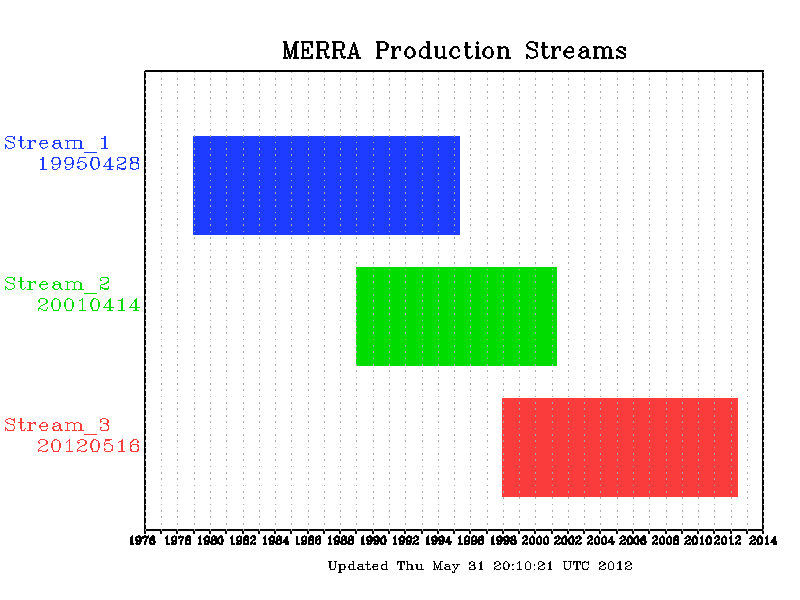
Production on the first two streams continued an extra two years of data, giving three years of overlapping analyses for 1989-1991 and 1998-2000. The data at the end of the run should be much better spun up than that near the initialization, so those data are also going to be released at the DISC. Our evaluation of the overlaps and transition between data streams will be posted in time, as will documentation of the overlaps.

Friday, November 6, 2009

Katrina Quick Look

In looking at some land hydrology in the southern US, a question came up on the effect of the 2005 hurricane season on the hydrology time series. So, we started looking around at the evolution of Katrina. This animation shows the MERRA version of Katrina (13Mb gif) moving over the southern tip of Florida and through the Gulf of Mexico. The colors show precipitation in mm/day and the white contours are sea level pressure (contour interval 2mb). The Best Track location is plotted every six hours. Firstly, the MERRA closed low pressure follows the best track fairly well throughout the evolution. This is notable only in that while MERRA does assimilate observations every six hours, there is no relocating or bogusing routines involved with the analysis/forecast cycles.

The MERRA resolution (1/2 degree) is not fine enough to get at the mesoscale structures in hurricanes, and we see that in MERRA where the surface winds (not shown) only reach Category 2 on the Saffir-Simpson scale (observations and estimates of Category 5 occurred during Katrina). Likewise, the rainbands at a distance from the central low are not well defined. The animation shows a curious shift of the main rain fall from the southern quadrant to the north, as landfall occurs (see also the figure below). In trying to validate this, we found radar data at NCDC, presented is in the second plot below, which agrees with the MERRA distribution. However, and also likely related to the resolvable scales in the MERRA grid, the heaviest precipitation in MERRA is a larger distance away from the central low than observed.

While this seems like it is a reasonable representation of the real system, and likely useful, users must consider carefully the limitations in MERRA or any reanalysis data set when applying it to a project.


Figure 1. MERRA precipitation (color, mm/day) and sea level pressure (mb) at 12Z29AUG2005 with the complete NHC best track path for Hurricane Katrina.

Figure 2 Nexrad radar rainfall at 12:32Z29AUG2005.

Tuesday, October 20, 2009

MERRA, MAC and LandFlux

In a recent paper, Bosilovich et al. (2009) evaluate 8 operational analyses to better assess the uncertainty of the physical fields (not the assimilated states) derived form (re)analysis systems. During the first phase of the Coordinated Enhanced Observing Period (CEOP) 8 international meteorological analyses were collected for a common period, along with supporting satellite and in situ observations. The model data is called the Multi-model Analysis for CEOP (MAC). In general, it was found that the global precipitation and outgoing long wave radiation derived from an ensemble of analyses provided fields that more closely resemble available observations than any one of the members.

For certain physical quantities, such as surface evaporation, a reliable method of observation is not available, and international projects such as SeaFlux and LandFlux are being developed to best fill the gap. In some research, data from analyses and reanalyses are taken as a substituted for observations. The figure below shows the MAC ensemble members compared with the ensemble mean. In places, there is as much as +/- 75 W/m^2 differences among systems. Comparison with such a data set can clearly identify outlying systems. Also, for certain research, using the physical fields from a single system may not be adequate.
Caption: MAC version 2 systems Latent Heat Flux differenced from the ensemble mean for July 2004. Version 2 includes the MERRA and ECMWF ERA Interim reanalyses in addition to the version 1 data. Mean and standard deviation of the difference fields are provided in each panels title.

More information on MAC and the data download are available.

Bosilovich, M.G., D. Mocko, J.O. Roads, and A. Ruane, 2009: A Multimodel Analysis for the Coordinated Enhanced Observing Period (CEOP). J. Hydrometeor., 10, 912–934.

Tuesday, October 13, 2009

Status and some recent analysis

Data at the download site are now continuous from 1979 through December 2006. To date, the data volume is approaching 70Tb, and in September alone, 5.7 million files totaling 91Tb of data were served.

Production continues toward real time, and June 2007 is halfway complete. The throughput is approximately 1 year every 6 weeks, so the production should catch up to real time in early 2010.

An overview of MERRA, including some recent results were presented at Purdue University Department of Earth and Atmospheric Sciences. This includes some evaluation of the global water and energy clycles and processes, however, the analysis continues and a peer review manuscript is in preparation. So, use these results accordingly.

Wednesday, August 5, 2009

AMS Annual Meeting, Jan 2010, Atlanta

The absttract deadline for the 24th Conference on Hydrology has been extended to Aug 10. Of note, abstracts regarding "Hydrometeorological representation and applications of reanalyses" are sought. The full list of conferences, themes and topics can be found at the AMS WWW page.

Tuesday, July 28, 2009

Further Production Update

Stream 2 has past the end of Dec 1997 and stream 3 has past the end of Dec 2005, so that we now have a time series from Jan 1979 through Dec 2005. The 1997 and 2005 data are still being assessed for quality, and should be posted at the MDISC site by then of the month or no later than early August.

Monday, July 13, 2009

Production update

Stream 1 has completed Jan 1979 through Dec 1988, catching up to the beginning of Stream 2. The reamining Stream 1 data will be released to the the download site within a week or so. Further, we are conituing Stream 1 for two additional years in order to study the initialization of Stream 2, and evaluate the transition of the data between the two streams.


Stream 2 should catch up to the begining of Stream 3 by the end of July. We we conduct a similar evatuation of the transtion between streams there as well.

Stream 3 production is on hold, pending a fix to allow for a format change in some of hte input data. It will resume ASAP.

Thursday, June 18, 2009

Land Interaction Processes


MERRA Production has been moving along steadily, still on track for a continuous time teries (1979-2006) to be available in early August. Data (missing 1988, 1997, 2005) is presently available for download, see the MERRA home page for access information.

With much of the record available, comparisons to previous studies of reanalyses are possible. For example, there has been a lot of work on the land interaction processes in NCEP and ERA40. Betts and Viterbo (2005) has defined cloud albedo as an observable diagnostic of the all-sky radiative forcing of the surface (Acld = -{SWDNsfc-SWDNsfcclr}/SWDNsfcclr). Below is an example of the cloud albedo comparison for ISCCP and ERA 40 over the Madeira basin, followed by a similar figure for MERRA. ERA40 tends to overestimate the cloud albedo, while MERRA underestimates it. This indicates that for the Madeira, the shortwave at the surface is
too close to the clear sky values. This bias is especially pronounced during the austral winter and less so in summer.


In evaluating the coupling processes, the links between the surface, surface layer and boundary layer relate to precipitation. Below, Betts (2009) shows the relationships of boundary layer (through LCL height in pressure thickness), surface layer (EF, evaporative fraction) and soil wetness (SMI). While lower wetness is often and indicator of higher LCL and lower precipitation, there is a range in the characteristic values. EF results are similar. The LCL - wetness connection in MERRA appears stronger and more linear than that of ERA40, where the MERA LCL height is almost double that determined from ERA40. (Note that the soil moisture index in Betts 2009 is not the same as the MERRA surface soild wetness, the SMI cannot be easily reproduced in MERRA data). The MERRA relationship between LCL and EF is much tighter than that shown for ERA40.


In the figures above, the colors indicate the amount of daily preciitation that occurs relative to the LCL and Wetness/EF values. For the MERRA figures, the dots are each daily mean showing the range in the data, and for ERA40, the range it demonstrated by the error bars.

Betts, A. K., 2009: Land surface coupling in observations and models. J. Adv. Model. Earth Sys. Articles in Press.

Betts, A. K. and P. Viterbo, 2005: Land-surface, boundary layer, and cloud-field coupling over the southwestern Amazon in ERA-40, J. Geophys. Res., 110, D14108, doi:10.1029/2004JD005702


Friday, May 22, 2009

March 1993 East Coast Snow

Recently, Midshipman S. Martin from the United States Naval Academy visited the GMAO, to learn about MERRA. The specific case study evaluated for a brief internship was the March 13, 1993 east coast snow storm (links to a recent Capital Gang discussion on the predictability of the storm). This was just a preliminary evaluation of how MERRA analyses represent the storm, in preparation for a senior paper.  As with the Feb 1979 storm (see the MERRA home page), we generated an animation (~8Mb) to get a sense of the storm track. 


Snowfall totals of 2 feet or more occurred at many observing stations. Below, the snowfall totals from Kocin et al (1995) are compared with MERRA. The northern extent of the heaviest snow seems to be a bit weak (in NY and western PA, for example) . The MERRA snow data was converted from snow water equivalent accumulated for the two days, and converted to snow depth using 10% snow/ice density.

At 12Z13MAR1993, the surface low was centered over Georgia, with the surface front extending southward through Florida. Aloft, the main part of the jet stream was North of the surface low, but a maximum in wind speed (likely a jet streak)was in the 300mb trough, lagging behind the surface front (below).

Looking closer at the vertical cross section through the trough and this wind maximum, we find a well defined tropopause fold associated with the 300 mb wind maximum. Below we compare the MERRA representation of the tropopause fold to a case study (1978) observed with aircraft measurements. The MERRA figure shows wind speed in black, potential temperature in dashed red and potential vorticity in shaded blue.


The main point here is that the MERRA analysis of the storm shows good dynamical structure of a very strong storm. More still would need done, evaluating the cyclogenesis, and how well the system physical processes through the lifecycle of the storm. However, this is one of the stronger examples of cyclogenesis in the MERRA period, and so another question is whether MERRA data can reproduce the dynamical structure of weaker storms. Ultimately it's a promising result so far.

Figures obtained from:

Keyser, Daniel. “Atmospheric Fronts:An Observational   Perspective.” In, Mesoscale Meteorology and Forecasting, 216–257.

Kocin, P., Schumacher, P., Morales, R., and Uccellini, L. (1995, February). Overview of the 12-14 March 1993 Superstorm. Bulletin of the American Meteorological Society, 76, 2, 165-182.


Friday, March 6, 2009

Mt Pinitubo Eruption Summer 1991


The eruption of Mt. Pinatubo in June 1991 was the second largest terrestrial eruption of the 20th century (Novaruption in 1912). This eruption ejected massive amounts of aerosols in the stratosphere. While global surface temperature dropped in the subsequent months, this caused an overall warming of the stratosphere in the tropical latitudes by several degrees due to absorption of radiation by the aerosols. Here, MERRA monthly means of 70mb temperature from August and then December of 199o are subtracted from August and December of 1991 to show that stratospheric warming by about 2 to 4 degrees C as the ejecta traversed the globe at this level during the subsequent months after the eruption.


Friday, February 27, 2009

Feb 19, 1979

The 1979 President's Day snow storm was a significant snow event in the North eastern US. This article presents an interesting review of the impact on the DC region and the modeling capability of the time. With the 30th anniversary of this storm, an animation of the MERRA depiction has been posted on the main WWW page. Here, we just compare a snapshot of the reanalysis to GOES IR imagery. The interesting part is that there is a clear break in the cloud structures of the storm develops over the Atlantic. This is not as apparent in the visible imagery (more like a continuous comma shape). MERRA cloud cover seems to catch this aspect of the storm. This data comes from the assimilation cycle of the system, forecasts for this case have not been run, but may be interesting.

The current estimate for when MERRA will catch up to real time is Fall 2009.

The MERRA cloud data is contoured from no cloud (black) to complete cover (white), the mean sea level pressure is contoured in purple. Wind barbs are colored according to the magnitude of the wind speed, and only 1 in 4 grid points are plotted.

For a study of the event, see: Bosart (1981)

Tuesday, February 24, 2009

MERRA Workshop Materials

The presentations from the MERRA Workshop have been posted on line at: http://gmao.gsfc.nasa.gov/research/merra/presentations/index.php

Also, the materials from the workshop, including documentation and software (Grads, with online access to the data) are also available online:

ftp://gmaoftp.gsfc.nasa.gov/pub/papers/mikeb/MERRA_Workshop/

Sunday, January 11, 2009

AMS Annual Meeting - MERRA Short Course

Today, January 11, we hosted the short course on MERRA and data access. We had 15 attendees from a variety of backgrounds, research and applications, universities and government. Also, there were a range of experiences, some familiar with reanalyses some no prior experience. Our objective was to provide the basic understanding of the system, how we validate and use the data in research and how to access the data (with traditional methods, and newer online software access).

The day started with and overview of the project and the GEOS5 data assimilation system by Michele Rienecker. Michael Bosilovich presented an overview of the validation prior to starting the reanalysis and the current description of the hydrological cycle and global energy budget. Steve Berrick described the access to the data and the various portals at the MDISC. Arlindo da Silva gave a wide ranging presentation on how many different software packages can access MERRA online data.

We were pleased to have Alan Betts give a lunch time presentation covering much of the work he has done over the last 10 years working with ECMWF reanalyses data. The afternoon was reserved for some hands on data analysis and processing activities. We provided digital handouts including many of the presentations but also some software and data that the attendees could run on rented laptops (or their own).

The first hands-on exercise was reproducing some of Alan's figures of ERA land atmosphere interactions except with MERRA data. Next Arlindo da Silva discussed the regridding and reformatting of reanalyses data with the theme of "Look-Alike" imitation. In other words, making MERRA look like NCEP reanalyses (or any other reanalysis) for comparison or reading into existing software applications.

One theme of the meeting was processing data online, not downloading data, but producing the answer with online utilities. This was primarily through GrADS Data Servers (GDS) . The Look-Alike hands-on activity included a walkthrough where participants created MERRA data files from the online data servers using a command line utility (lats4d). Following that, Michael Bosilovich showed examples of using serverside calculations to improve the efficiency of online GDS calculations.

Lastly, Dana Ostrenga of the GSFC MDISC demonstrated the Giovanni access and evaluation of MERRA data, including the along track (satellite track) utility soon to be released. This will allow comparison of MERRA vertical sections compared to A Train data, such as Cloud Sat.

We are currently preparing the materials (including software and presentations) for WWW distribution and will post a message here when they are ready. The networking and online data servers performed well during these exercises.

Saturday, December 20, 2008

Hurricane Andrew, Aug 1992

MERRA Stream 2 has completed through 1993. We have been looking at various weather and climate events. Hurricane Andrew was a powerful, but fairly small hurricane. MERRA's 1/2 degree resolution is likely too coarse to adequately resolve the circulation, and there is no bogus or center relocation being done in the system. Still, assimilation of observations will show some circulation or feature.
There isn't much of a circulation prior to landfall in Southern Florida. Landfall was at 9Z24Aug1992. Figure 1 shows the sea level pressure and wind barbs from 6Z the closest analysis time before landfall. The pressure center is much higher than the observed center pressure (955 mb). the center of the pressure is located south of the best track at that time. The feature that really attracted attention is the offset of the wind circulation, even further south than the pressure center, and crossing the isobars at the center.

Figure 1 MERRA Sea Level Pressure and 1000 mb wind barbs from the 6Z 24 AUG92 analysis. The blue line shows the best track befre and after landfall, with red markers at 00Zs.

A closer look at the observations being assimilated shows that ERS1 did track over the center of circulation around 6Z. Figure 2 shows all the observations accepted into the analysis. There are ERS1 wind vectors crossing the center of the circulation, and the assimilation system accepted the data. The vectors closest the center are likely contaminated by precipitation, and should have been rejected. At this point, it's not clear how often this kind of problem occurs, or what might be done to detect and reject the bad data. It's under investigation.
An important point for reanalysis users, especially as resolutions are increased to better resolve weather and smaller scale circulations, is that reanalyses are assimilating vast quantities of observations. sometimes poor quality data does make it into the analyses. While quality of data and analyses are improving, users still need to consider that features may or may not be realistic. Likewise, we are providing some information on the accepted observations in MERRA. More difficult is providing access to the users on the actual observations.


Figure 2. MERRA analysis sea level pressure, analysis streamlines and windbarbs showing the accepted observations (red is buoy or ship, black is ERS1). Most of the ERS1 vectors seem to agree with the mass field, however, close to the center of the low pressure the ERS1 vectors are crossing the isobars. The wind analysis is drawing to the observations, even when they disagree with the mass field.

Thursday, December 4, 2008

Initial Data Available

This is a short note to inform you that the first years of data have been opened for access at the Modeling and Assimilation Data and Information Services Center (MDISC). The announcement can be found here: http://gmao.gsfc.nasa.gov/research/merra/data_access.php

Instructions for download and visualization are available at: http://disc.sci.gsfc.nasa.gov/MDISC/

Documentation and status of the system and data files are at the MERRA WWW page: http://gmao.gsfc.nasa.gov/merra/

While there are a number of tools for access, to download large amounts, probably the most straightforward way is to follow the links through Mirador (a search and order program). This will provide a script that will ftp the data back to the user. Alternately, Mirador can provide pointers to the ftp location of the data, which can also be copied with "wget".

Keep in mind that the data is not yet a complete time series. Links to production status are provided above. However, there is a lag between production and data availability at MDISC required for quality checking of the data files.

If you do download data, please be sure to sign up to the MERRA news listserv at the MDISC site. As issues related to the scientific understanding of the data and system become known, we will make every effort to communicate this information to users. The listserv is the most direct way to contact users.

We are also forming a FAQ list and citation lists. The content of these are directly related to users providing information back to the GMAO.

Sunday, November 9, 2008

MERRA turns 11, Global Energy Budget

Last week, MERRA had produced 11 years of data across all 3 streams (79-82, 89-92 and 98-00). Here is a quick evaluation of the global energy budget so far. The reference values are a recent update from Trenberth et al. (2009, BAMS accepted DOI: 10.1175/2008BAMS2634.1). There is a difference between MERRA and this reference, where MERRA is averaging all 11 years, while the reference data was developed from theory as well as observations and reanalyses from March 2000 - May 2004. MERRA is presently in 2001, so it will be a couple months before we can reproduce the global energy budget for this exact time.

(In the figure, MERRA data includes 130 months written in red)

At the surface, too much shortwave, and not enough longwave reach the surface, while at the top of the atmosphere, too little shortwave is reflected and too much longwave is emitted. This suggests that the cloud fraction is too low or cloud optical properties too thin (or both). It is interesting to note that the values tend toward improving in time toward the 2000s. A discussion on the trends in the global energy budget is being prepared.

Some other interesting features occur. The overestimate of the shortwave energy (primarily over the ocean) into the surface is not translating into increased sensible, latent or upward longwave fluxes. Instead, it contributes to the imbalance at the surface, and since the SSTs are prescribed the surface is not warming. Also, the difference of precipitation and evaporation reflect the influence of hte analysis increments on the water budget (globally taking water out of the system).

Trenberth et al (linked above) provide more discussion on the global budget, as well as comparisons to the NCEP and JRA reanalyses.

Friday, October 17, 2008

Severe Freeze in South America

While looking over the area average time series of the Amazon River basin produced by MERRA, a very cold event was apparent in July 1981. Figure 1 shows the time series of 850 mb temperature for the basin, and the event is several K colder than earlier in the reanalysis. The cold event starts around July 16 1981, and lasts a few days. Looking at the observation reports from this period, did not show any major problems with the input obs, yet the analysis increments of water vapor show a strong shift, starting with this event (Figure 2). So, the shift in the increments along with the temperature spike suggests, at first glance, a problem. However, the lack of rejected observations or increased error in the forecast says the observation and assimilation are OK.

While considering the problem, Austin Conaty used Google Scholar to search for cold events in the Amazon. It turns out that there was a strong system pushed northward across the continent bring cold air and a freeze to Brazil (Fig 3 from Fortune and Kousky, 1983). By looking at the Amazon Basin area average, we see the cold anomaly push into the basin. While it looks out of place, it is a real feature. We'll file this under, you learn something new every day.

Figure 1 Time series of Amazon basin average 1 hourly 850 mb temperature (K) for 1979 through 1981. The July 1981 cold anomaly stands out in this relatively short time series.

Figure 2 Time series of area averaged analysis increment of water vapor daily averages (dqvdt_ana, mm/day) for the Amazon basin from May 1981 through Sept 1981. As the cold air enters the region, the analysis increments shift (becoming smaller negative values).

Figure 3 Synoptic maps of the cold air event, brining a sever freeze to Brazil, copied from Fortune and Kousky (1983, MWR).

Friday, October 10, 2008

Known Issue #1, east Atlantic anomaly

Recently, an evaluation of the global energetics identified an anomalous feature, a bullseye, off the coast of Portugal during most of 1979 and 1980. The anomaly affects many tendencies and variables in this localized region. Figure 1 shows the JJA 1979 Analysis Increments of temperature at 500 mb, the center of the strong negative increment is a persistent radiosonde that appears to be flawed, compared to other nearby sondes. However, it was not rejected by the data assimilation's quality control. The sonde itself is being researched as to whether it is mislocated or just poor quality. Regardless, 1979 and 1980 data have a localized problem. The data will still likely be made available, as other regions around the globe, and certain global parameters are not as dramatically affected. However, we will try to alert users to this issue, as it will affect any investigation of the weather in the eastern Atlantic Ocean or possible western Europe (Figure 2).

The current plan is to re-run the affected period at a later date, however, that re-run will not replace the existing data, but be placed alongside the existing data. We will continue to use and evaluate the current 1979 and 1980 data, and if other issues arise, fixes could also be incorporated into the re-run. Also, with this problem, a new page will be created for the MERRA WWW site to catalog issues with the data as they arise, and include any actions to those issues.


Figure 1 JJA 1979 analysis increments of temperature (DTDT_ANA). The questionable sonde is causing the negative increments circled.


Figure 2 Temperature differences (MERRA-JRA25) at 850 mb for JJA 1979. The low temperatures resulting from the questionable sonde are apparent west of Portugal. The featuer is also apparent in the surface pressure fields (not shown)

Friday, September 26, 2008

Integrating Earth Observations

One of the advantages of reanalyses is that many different sources of observations are combined in a global gridded consistent system. We have a brief overview of MERRA and the challenges facing reanalyses published in the online IEEE magazine Earthzine www.earthzine.org. There are a number of interesting interviews and articles at the site as well.

Tuesday, September 23, 2008

MERRA Short Course at AMS

We will have a short course at the AMS Annual meeting January 11 in Phoenix AZ. It will cover an overview of the system and physics, the validation that we have already done, but the most important and interesting component will include several hands on tutorials working with data online. Given that the volume of data will be quite large, the subsetting and previewing tools should be useful to researchers to target the data they require. The audience will likely be graduate students or researchers who work directly with the data. Several tools that are used regualrly at the GMAO to manipulate the data, formats and grids will be demonstrated.

The announcment is on this page: http://www.ametsoc.org/MEET/annual/call.html and the registration is currently open. The AMS will shortly publish an agenda, and we are currently working on adding more details to that regarding the tutorials.

While MERRA won't be completed by then, it will be nearly halfway complete. Also, by then data will be accessible online.

Friday, September 5, 2008

Status and File Spec

Production of MERRA data has been progressing at 10 days per day on three streams, which is what is expected. Data monitoring is going on regularly, and the system seems to be moving along at the expected data quality. We have some time series routines being run, and will report on those when we achieve 8 full annual cycles. Currently, Streams 1 and 2 have more than 2.5 years each, and stream 3 has 22 months.

The MERRA File specification document has also been updated and reflects exactly the data files being produced. The document can be found at the bottom of the MERRA home page, and a link is provided here.

Wednesday, July 30, 2008

MERRA mail list

A mail list has been established to pass on news and alerts regarding MERRA especially the data. Send an email to majordomo@listserv.gsfc.nasa.gov with the body of the message "subscribe merra-news"

You will receive a message with instructions to confirm the subscription.

Friday, July 25, 2008

AMS Annual Meeting - Abstract deadline Aug 1

There is a planned session on reanalyses at the AMS Annual meeting, co sponsored by the Committee on Hydrology and Climate Variability and Change Committee. The deadline is August 1. Please see the call for papers:
http://www.ametsoc.org/MEET/annual/index.html

Thursday, July 17, 2008

Status July 17

Late last week, the computing platform running MERRA was brought down for scheduled maintenance including an upgrade to the operating system. When it was brought back online, numerous scripts and control jobs for MERRA were broken. The science and executables for MERRA remain, but the control of jobs and data flow needed to be patched for the new OS. At this point, the three MERRA streams are processing forward. However, some post processing scripts are still being patched, such as the information on our Production Progress and Quick View pages. Those should be back on line in a few days.

Tuesday, July 1, 2008

Brief Comparison with Interim Reanalysis

Recently the ECMWF Interim reanalysis has been released (see http://data.ecmwf.int/data/). We have a quick overlap and look at a comparison with MERRA at monthly time scales for January 1998.

The figure below shows two features of the MERRA system we have been tracking since the system was under development, 1) negative zonal wind bias in the tropics and extratropics and 2) dry bias in the lower troposphere, especially the tropics. These are apparent against each of the existing long reanalyses (see the quick look page for more comparisons). However, in comparing ERA40 and the new Interim reanalyses with MERRA, the magnitude of the differences is smaller compared to Interim.

At this time monthly files are not available on the ECMWF site. When those become available for download, we will integrate the Interim data into the quick look pages for comparisons.


(Gary Partyka, GMAO, downloaded the Interim data and performed the comparison and evaluation.)

Sunday, June 15, 2008

Status June 15

Just a brief update. The updated sonde fixes seem to be going well. The restarted Stream 3 is into March 1998, and we have evaluated the early data. Stream 1 has completed 1979, and Stream 2 will complete 1989 in a day or so. While their has been scheduled downtime for the computing system (Discover), recent upgrades have paid off with 11 days/day of throughput per stream.

Sunday, June 8, 2008

Status June 8

Streams 1 and 2 have been progressing, and full years should be available by the end of this week.

Stream 3 was held for the revision to the sonde data (station identifiers and launch times, see the May 23 post). However, it was decided to restart from January. Stream 3 is presently restarted and at Jan 11 1998.

Thursday, May 29, 2008

MERRA Quick View

We've just opened a new link on the MERRA WWW page. It is a version of what our monitoring team is using to look quickly at various aspects of the circulation and water cycle. We'll be adding some other figures, like time series of the monthly data as well.

http://gmao.gsfc.nasa.gov/research/merra/prequel/view.php

Friday, May 23, 2008

Status May 23

All three runs streams are progressing forward, 5 months in, approximately. However, as some folks here were making corrections a few weeks ago there were some unusual reports in the sonde data. Further investigation has found a problem that is fairly easily correctable. Actually there are two problems, and they change in time.

Starting around 1988, the actual launch time isn't being considered, just the synoptic time of the launch. From 1988-1992, this occurs in less than 1% of the launches at any given synoptic time. After 1992, the rate increases to around 10-15%. The consensus is that the impact to the 1989 MERRA stream is small, and we can have this fixed by the time we cross 1992. However, in 1992, a more serious problem occurs. Then, some sondes are not labeled correctly as to their manufacturer. This then affects whether the radiation correction for certain sondes is called, and the radiation correction is important to handle correctly. This occurs at a rate of about 15% at any given synoptic time, also a fairly large number. Again it can be corrected for the 1989 stream, before it gets serious.

The 1998 stream is another matter. Both of these problems are occurring at a rate of about 15% per synoptic time in January 1998 and on. So, the data we have processed for the 1998 stream has a flaw than needs to be corrected. In order to stay timely with the MERRA processing, we will continue the 1998 stream to 1 July 1998, at which time the fixed sonde data will be implemented. The Jan - Jun 1998 data processed so far will not be released. Instead, we will continue the 1989 stream to recover this period, and there will be overlap through 1998 to ensure that the transition of streams is as smooth as possible.

A word about the source of this error. We are using recently reprocessed sonde data from NCEP, and working with NCEP closely on monitoring and quality controlling this data. This is the data set that would also go into the NCEP CFSRR, but is not the same as has been used in previous reanalyses.

So in summary, there is no impact on the 1979 data stream. The extremely small number of launch time errors early in the 1989 stream are considered to be nominal, and the sonde data will be fixed as soon as possible. The 1998 data from Jan - Jun must be redone. The fix to the data will be implemented on Jul 1998.

Monday, May 19, 2008

Status May 19

All three streams have progressed through March and into April of their respective first years. Evaluation of the primary diagnostics and data usage seems as expected, and these first few months have passed monitoring tests. The data has been approved for transfer to the GES DISC, where the data will be available for download.

We are still testing some of the software for accessing the data files. However, it won't be held for any significant length of time. When we get a schedule for opening the data, it will be posted on this site.

The runs seem to be going smoothly, and with throughput back near the 10 days per day level. (a good sign).

Wednesday, May 14, 2008

Status May 14

All three MERRA streams have been running, and past their respective first month. We have started evaluating the first months, so far no surprises. The evaluation is not yet completed. The vertically integrated budget diagnostics are fully incorporated in this version, and the online file specification document should be updated soon. The budgets are complete and deep into the terms of the equations, owing to the thoroughness of Larry Takacs and Max Suarez. We'll try to post some more information on this soon.

We still are only getting 8 days per day throughput. A planned upgrade to the computing system should improve I/O, and is expected to help regain the throughput.

Friday, May 2, 2008

Status May 2

The fixed tag of the data assimilation system has been handed off to operations. They are preparing to restart the streams. However, we found that the updated PAOBS data had a problem in 1988. A different data format has caused problems there, but not in any other
data files. The 1988 PAOBS are being reprocessed. Since this affects the start of the 1989 stream (stream 2), it will continue to hold for the data fix. Otherwise, we should see Streams 1 and 3 restart today.

Thursday, May 1, 2008

Reanalysis Information and Precipitation work

The previous post on reanalysis precipitation climatology was some extra information from a paper recently accepted at the Journal of Applied Meteorology and Climatology, the pre-press version is available online at AMS. Evaluations of the GEOS5 precipitation are discussed in the last section.

More generally, the extended abstracts from the 3rd International Reanalysis Conference has been published online. See the email copied below.

begin message -----

Dear Participants

We would like to announce that the extended abstracts of oral and poster presentations at the third WCRP International Conference on Reanalysis that took place in Tokyo, Japan, 28 January- February 2008, are now available at following URL.

[World Climate Reanalysis Programme]
http://wcrp.ipsl.jussieu.fr/Workshops/Reanalysis2008/abstract.html

Thank you for your cooperation,

Best regards,

Eriko Moriai


Secretariat for WCRP International Conference on Reanalysis

Thursday, April 24, 2008

Status April 24

The three streams are holding at the end of their spin up periods. Some refinements are being made to the budget output diagnostics for better closure. We have also been reviewing our input data holdings. A gap in the PAOB data set was found from 1997 through the end of 2000. The PAOB data starts back up in 2001 through our CDAS input data stream.

After checking this issue with Jack Woolen at NCEP, we found that he had just finished preparing revised PAOB data set (including about 4x more data) from 1985-2000 using JRA25 and ERA40's data holdings. In short, we are aiming to implement these data (many thanks to Jack, and counterparts at JMA and ECMWF). So, the restarts will be delays a few days to test this implementation.

For further information on PAOB, see http://www.bom.gov.au/bmrc/basic/wksp16/papers/Seaman.pdf

A consistent positive impact from the PAOB data suggests that this is worth a couple days to put into the system.

Friday, April 18, 2008

Status April 18 - Rewind

The data drop reported in the last status posting prompted some deeper digging in the input data streams. One issue led to another, then another. Briefly, a bug fix that should have been zero difference actually caused double counting in some of the input data streams, affecting the 1979 and 1989 streams. Further, a resource file had incorrect settings in the 1998 stream, leading to several observation systems not being assimilated.

The net result is that the data cannot be used as expected, and almost all the production processing needs to be re-run. The estimate for getting production restarted is Wednesday Apr 23. In addition, these errors have exposed some blind spots in our monitoring routines and adjustments are being made, and more personnel time is being devoted to monitoring.

Tuesday, April 15, 2008

Status Apr 15

Over the past weekend, Sondes dropped out for a day (mid-Oct 1979) from the data stream (they exist, but the something in the computing environment skipped a beat). So, on Monday AM 4/14, the 1979 stream was backed up to the previous restart before the data drop, and restarted. The monitoring team is looking for issues like this routinely.

Checkout the revised Production Progress web page. Updated regularly with the current day that is being produced.

http://gmao.gsfc.nasa.gov/research/merra/progress-events.php

Friday, April 11, 2008

Status Apr 11 - Long

There has been much going on, and a lot keeping me from these updates, unfortunately. There are several items I'll include here.

First, our late 90's "scout run" (2 degree resolution, same system as MERRA) was running well ahead of the reanalysis, but encountered a problem in a single file of MSU data. There was a corruption in the input file. it has been found and corrected. That's the benefit of these coars scout runs, they should find the problems that would otherwise slow down the processing.

The system had been running at just over 10 days per calendar day for some time. However, we have been only getting ~7 days per day lately. It's a technical problem that the computer folks are working. It basically comes down to increased usage on the machine, affecting the MERRA jobs. People are looking at it, to try to get the performance back up.

We have a monitoring routine established. Some climate maps are being inspected each month of reanalysis. (Some examples posted below) Soon we hope to make those available on the internet. The monitoring code also includes range checking on each and every variable and layer produced by the system. We have some hits in the range checking from variables SHLAND (land only sensible heat flux) and TSTAR (surface layer temperature scale). TSTAR seems to be spiking sporadically, but in conditions with low wind speed and near the change from night to day (stable to unstable) conditions. It does not appear to be a severe problem, there is no plan to stop or back up MERRA for these flags. SHLAND is showing range check errors at a few, very repeatable points. Those are where the fraction of land is much smaller than that for ocean. So, it appears that ocean is driving a surface atmosphere that is causing convergence problems in the land parameterization where the fraction of land is small. For example dry soil with a dominantly tropical ocean point. So far, the grid average sensible heat seems reasonable, so there is no immediate plans to correct this, or stop and rewind MERRA.

Range checking has also found occasional occurrences of shortwave radiation diagnostics are reporting negative numbers. The magnitude is very very small, and the result of roundoff in the interpolation, and not protecting against such negative values. The net effect of these should be extremely small, but may trip code that expects perfectly zero values of shortwave radiation components. Users will be advised to clear such negative values.

A systematic difference from other reanalyses has been occurring monthly and in each season. Below the zonal specific humidity and 850mb map of specific humidity compared to ERA40 in JJA 1979 is attached. These biases were noted in validation. The contour interval is small and the range close. The MERRA data is dry in the tropics at 85omb and wet above 700mb. This is an interesting result, considering that the total column water and precipitation have been very well reproduced.

There's more to come, including online access to figures that the GMAO is using for monitoring.

Zonal mean specific humidity for JJA 1979 compared to ERA40.
850 mb Specific Humidity for July 1979 compared to ERA40.
Global Precipitation difference of existing long reanalyses compared to GPCP (CMAP differences included for reference) for July 1979.

Tuesday, March 18, 2008

MERRA FAQ

We have started to put together a list of frequently asked questions regarding MERRA. Obviously, it will grow with the frequency of questions. Comments or questions posted here will also contribute to the list.

http://gmao.gsfc.nasa.gov/research/merra/faq.php

Friday, March 14, 2008

Status Mar 14

All three streams have been running, though there was some down time on the supercomputer last night. So far:

  • Stream 1: 19790227
  • Stream 2: 19890121
  • Stream 3: 19980109
When the jobs are running, we get ~10 days per real day from each stream.

Tuesday, March 11, 2008

Status Mar 11

All three MERRA streams are running. Stream 1 has just finished Jan1979, so we'll be evaluating that tomorrow. Streams 2 and three are still in their final spin up period, but will be finished with the spin up by tomorrow.

We have a link to an image that is regularly updated and shows how much data of each stream has been produced, as well as how much data is left to produce.

http://gmao.gsfc.nasa.gov/operations/merra_status_production.gif

Needless to say, at this point we have much more to do.

Friday, March 7, 2008

Status Mar 7

All the updates are checked in and Stream 1 (starting 1979) has restarted. Streams 2 and 3 should also start soon.

Wednesday, March 5, 2008

Status Mar 5, Rewind

Since the last post, we found that the coefficient update being implemented (and a required fix) also affected the MSU data for TIROS-N which is the only satellite data in early 1979. Since this is a non-zero difference, we need to rewind the 1979 MERRA stream (it had progressed to the start of NOAA-6, July 1, 1979) and rerun.

While testing the updated coefficients, some zero-difference updates to the output diagnostics were incorporated to the system. The updated tag is being handed back to operations, who should be able to restart Stream 1 (1979) before the end of this week. In looking at the first 6 months of the 1979 that is being rerun, the output seems much as we expected from validation experiments.

We still have some backlog in the computing queues for other projects, and we are going to rerun our 2006 validation experiment with the updated coefficients as a formal validation of the implementation of this update. It is important to not that the model physics and generally the data assimilation has not changed in some time, and the bug fix to these coefficients are part of the input data stream.

Saturday, February 16, 2008

Status Feb 15

The MERRA Stream 1 (starting Jan 1979) has been progressing steadily, up to mid March 1979. We've had a look at Jan 1979, and it looks to be within expectations. The second two streams are on hold, mainly because there are some short experiments still being run.

However, it has also come to our attention that the CRTM team are fixing a bug in the coefficients for MSU radiances. Stream 1 won't assimilate these until July 1979, but the second stream will assimilate these immediately. The hold for the short runs will continue through next week, at which time the status of the update to these coefficients will be reevaluated. However, all indications are that the reanalysis should not proceed until these are included in the CRTM. This is an interesting development. We'll run some tests of the impact of the bug fix.

So, in the mean time, we can continue the processing of the Stream 1, and evaluate it along the way. Some results will be posted in the next couple days.

Sunday, February 10, 2008

Status Feb 10

One of the last few fixes included in the system (discussed in the previous update), one that should have been minimal impact, greatly affected some code in the data assimilation. The result was that many wind observations that should have been assimilated were not. The problem was apparent (actually the system crashed), so the fix has been fixed.

There have also been several down times in the last week while some updates were made to the computing platform. So far, it looks like the data stream starting in 1979 has been running continuously (or at least regularly) over the weekend. It is up to 15 JAN 1979 after starting on Friday in December 78. So, if all goes well, by Tuesday we should see the first month of MERRA data.

With all the down time, some short reprocessing experiments that the GMAO is producing for instrument team support have been delayed. So, there is a backlog that is being cleared out. Once clear, the second two streams will be restarted from Jan 1989 and Jan 1998, respectively.

Thursday, January 31, 2008

Status Feb 1

The three streams are ready to start. The first has run from Jan 1 1979 to Jan 9. However, all are on hold while system maintenance is being done (in other words, the computers are down).

By Monday, I'll be back from the 3rd International Conference on Reanalyses in Tokyo Japan, with better information. It has been a very interesting meeting, with status updates from the 20th Century reanalysis project and the NCEP CFS Reanalysis and Reforecast project (see the ppt at the CFS Site). Stay tuned to these interesting activities too!

Sunday, January 27, 2008

Status Jan 28

The three spinup runs reported earlier have completed 1 year of spin up. These have provided the starting points for the MERRA production. The output diagnostics have been updated to correct minor diagnostic bugs, and when the system is rebuilt, production will begin.

I'm monitoring status from the 3rd WCRP International Conference on Reanalysis, and will this page when new information is available.

Saturday, January 19, 2008

Status Jan 19

A data flag was out of place, and Stream 1 had to be backed up. All are still moving forward to the end of the December of their respective spin up phases.

Stream 1 date completed: 19781202

Stream 2 date completed: 19881124

Stream 3 date completed: 19971124

The at the end of December of each stream, the system will be rebuilt one last time.
While checking the output data, several minor bugs were found in the output, but nothing that changes the physics. A few other bugs have also been found, which may be non-zero in the physics. These are present being address, but none are considered to be significant changes to the results or validation of the system.

Generally, when the system is running 10 days of reanalysis are produced every day, from each stream. This may not add up with extrapolations from recent posts, because of computer downtime, or backing up the system.

Saturday, January 12, 2008

Status Jan 12

The Spin Up periods are still being processed.

  • Stream 1 RUNNING at 11/01/78
  • Stream 2 RUNNING at 09/26/88
  • Stream 3 RUNNING at 09/27/97
A group of GMAO folks have begun a final check of consistency between the output data files and the file specification document. The group will report back next Thursday.

Friday, January 4, 2008

Status Jan 4

Over the holidays, the last few science fixes went into the system, and the spinup periods resumed. Each of the three MERRA processing streams is presently running, with the data to be discarded for spinup.

  • Stream 1 RUNNING at 08/31/78
  • Stream 2 RUNNING at 07/30/88
  • Stream 3 RUNNING at 07/30/97
As a reminder, the planned start day for each stream is Jan 1, 1979, 1989 and 1998 respectively. They are moving at approximately 10 days per day, when the computer systems are up. They will hold at the end of each November, so that the last patch of the system (engineering fixes to the output diags, scripting and post processing that do not affect science) can be put into place. At that time, the GMAO will also make an evaluation of the output diagnostics, to ensure that the data and units all match the file spec document.

There is a known issue already becoming apparent. The CRTM coefficients for NOAA 8 AMSUA channel 14 have some problems. This data doesn't begin until May 1983, so there is time to correct the problem without affecting the MERRA production schedule. Further updates as the run get closer will be provided.

Happy New Year!

Wednesday, December 5, 2007

Reanalysis Precipitation Climatology

On the MERRA WWW page, we are posting several figures showing the comparison of 5 satellite era reanalyses with GPCP and CMAP precipitation data sets. There are some similarities among the reanalyses, in their differences from the observations (Tropical precipitation, and interestingly European continental January precipitation), but also differences between the merged observation data sets (GPCP has lower tropical precipitation than CMAP, but higher January precipitation, in general). Citations are provided on the page, that provide some analysis and discussion on the sources of bias. However, there are many other aspects in comparing reanalyses to the observed data. These are only climatologies, so that interanual variability, weather scale and diurnal cycle differences are not expanded.

The WWW page is at: http://gmao.gsfc.nasa.gov/research/merra/reanalysis_precipitation_climatology.php

Please take a look, and feel free to make comments on this blog.

Thursday, November 29, 2007

Status Nov 29

Just a brief post. The spinup runs are still on hold. The physics in the system seems to be set and the output diagnostics are likewise set. The main hold up is that the adaptive bias correction of a small number of channels over land is not stabilizing even after long (coarse resolution) runs, and continues to grow ultimately leading to the rejection of observations that should otherwise be accepted. A patch seems to be working, and a clean experiment is getting underway today. The spinup experiments should be restarted soon, and that will be posted here when it happens.

Tuesday, November 20, 2007

Summary of the MERRA User's Review Group Meeting

In late 2005 a MERRA review group was formed from experts in various aspects of Earth system science and users of existing reanalyses. Their charge was to review the GMAO strategy for MERRA and the validation experimentation and results, possibly contributing some of their own analysis. The goal for GMAO was to gain a preliminary assessment of the scientific merit of the GEOS-5 data assimilation system for MERRA prior to full production. In September 2007, the validation experiments began, and on November 7, the user review group met to discuss the results of the validation experiments with the GMAO and NASA HQ representatives.


The GMAO started the day, presenting a summary of the system and critical improvements in recent months (Rienecker), the dynamical circulation, clouds and radiation (Suarez and Bacmeister), climate variability features (monsoons, hurricanes, low level jets (LLJ) and diurnal cycle - Schubert) and precipitation statistics and land hydrology (Bosilovich and Koster). Key points from the presentations are summarized below.

Michele Rienecker reviewed some major and critical changes to the system since the inception of the Review Group. These include improvements in the use of retrieved wind speed over the ocean, improvement in the radiance assimilation (through the latest CRTM radiative transfer coefficients), corrections to bias and jumps in the radiosonde observations and a fix for diurnal cycle of glacier surface temperatures.

In looking at zonal circulation, Max Suarez showed the differences between the GEOS-5 and other reanalysis systems for winds, temperature and humidity. For example, the GEOS-5 eddy heights compare with ECMWF operational analysis both in a mean sense, and in the interannual variability. With small contour intervals in the zonal cross-sections, differences in tropopause height can be identified among all the reanalyses. In addition, GEOS-5 reproduction of stratospheric ozone profiles is reasonable, and a limited comparison of the beginning of a quasi-biennial oscillation looks promising. One possible systematic problem is high upper troposphere humidity (as compared to ECMWF and NCEP operational analyses). The radiation fluxes have some bias, as well, but these are somewhat reduced compared to the existing reanalyses (Figure 1).

Siegfried Schubert reviewed some evaluations of monsoonal circulations, including the North American monsoon and Indian monsoon. GEOS-5 reproduces the low level winds (e.g. the Somali jet and the Great Plains LLJ) as well as the subseasonal breaks observed in the monsoonal precipitation. There are some apparent regional biases in the precipitation, but this is also true among all the existing reanalyses. The GEOS-5 North American monsoon circulation and precipitation compare well with the North American Regional Reanalysis (NARR) (for July 2004, Figure 2). Globally, the interannual variations of precipitation compares well with observations, and better than existing reanalyses. In addition, the monthly average water budget shows globally averaged analysis tendencies to be a small value (Figure 3). However, the diurnal amplitude of continental precipitation is large and the phase is shifted to a daytime maximum compared to observations. This is a problem for all reanalyses, and it persists in the GEOS-5 system.

Mike Bosilovich reviewed monthly mean precipitation, where GEOS-5 generally produces good fields compared with GPCP and CMAP, not only in the global mean, but also spatial correlation. In addition global P-E is generally small (near zero) indicating that the global analysis is relatively well balanced (but will be non zero). The GEOS-5 precipitation is reasonable in many regions and latitude bands. Comparisons for the Mississippi River basin precipitation against daily gauge data show the GEOS-5 was able to produce the daily precipitation events, and the no-rain days for Jan-Oct 2004 (Figure 4). However, maximum intensities in the warm season are underestimated, leading to an underestimate of the total basin precipitation. Randy Koster’s analysis of the time series of precipitation shows that the occurrence of rain during the day coincident with solar forcing causes high interception loss of water vapor, and then the runoff water is underestimated. The transition of the observing system to include SSM/I was tested in a data withholding experiment. GEOS-5 tropical precipitation increases with the inclusion of SSM/I, but the increase is less than 10% of the tropical precipitation (in contrast, JRA25 has a change in extratropical precipitation). There is also a small increase of total column water, ocean surface winds and ocean evaporation.

The overall conclusion is that the GEOS-5 system can produce many aspects of the Earth system as well or better than existing reanalyses. The quality of the data coupled with the fine temporal and spatial scale of the data should make the GEOS-5 reanalysis useful for many purposes. While there were spirited discussions among all the participants, the external user group members’ sentiment reflects this conclusion as well. As of November 2007, the reanalysis data streams are being spun up, and data should start flowing to the scientific community early in 2008. The full MERRA data product will take approximately 18 months to generate.


Figure 1 Monthly mean (Jan 2004) TOA Longwave radiation differences between CERES ERBE-like observations and several reanalyses and operational analyses.

Figure 2 Comparison of the seasonal evolution of the North American monsoon between the North American Regional Reanalysis (NARR) and GEOS5.

Figure 3 Global vertically integrated water vapor budget for July 2004 including the physical components, the analysis increment and residual.

Figure 4 Mississippi River basin area-average (over all sub-basins) daily precipitation for January – September 2004. The figures show the scatter of the daily data, the daily time series, and the accumulated precipitation. The observations are CPC daily ¼ degree gridded gauge data.

Friday, November 9, 2007

Status Nov 9

The validation of the system has been somewhat time consuming between this post and the previous, and much has happened. At least 20 GMAO staff (or more) spent several weeks interogating the validation experiments each focusing on various Earth system components. On Oct 11, the GMAO held an internal review of the validation experiments. On Nov 7, the summary of these results were presented to our User Review group in a meeting at GSFC. My interpretation of the Review is that the system has more than enough scientific merit to proceed to production phase, weighing the advances and advantages against the limitations and some weaknesses. When any formal writing from the Review are made available for public posting, I'll put it on the blog. This is a significant milestone for the MERRA project and the GMAO.

There were many very positive results that came out of the MERRA validation experiments. Too many to easily synthesize into blog posts. A validation document is under development, but should take some time. Some results will be posted here as time goes on. In the near term, however, validation pointed out a serious flaw in the system. When the CERES science team evaluated the data, they found that Antarctica and glaciers did not have a diurnal cycle of surface temperature. The reason ended up being a thick glacier layer. Some new code, including a thinner layer and revisions to the energy budget code have produced very reasonable results. So, this fix will be added to the MERRA system. (see the Figure)

Figure: Time series of 2m air temperature at two Antarctica stations. The green line indicates GEOS5 Patch 15, Blue is patch 20 (including the fix) and the read is ECMWF operational analysis. Model data are the nearest gridpoint to the stations. Station data is marked with a black box.

So, the spin up of MERRA production runs are on hold until the system is updated. Some testing of convection parameterization coefficients has been going on through this process. A decision is pending on which, if any, will go into MERRA. The issue to be resolved are, updating the system with new glacier surface temperatures, finalizing the MERRA output routines and final evaluation of the convection parameterization. Spinup runs will restart once these issues are resolved.